
Join us for this video series beginning in January 2025. Registrations is now open! https://fivemooreminutes.teachable.com/courses/

Join us for this video series beginning in January 2025. Registrations is now open! https://fivemooreminutes.teachable.com/courses/
It’s been a year and a half since this was published. I’ve often been asked how long it took to write. My response? It feels like I have been writing it for decades. Every time I learned something from one of the folks who have paved the way, I have been writing it in my head. Every question I have been asked has informed the work. Every question I have asked has found its representation in those words.
How have things changed in the last year and a half? The number of times I have been moved to tears by people sharing how it has impacted them is one of the most unexpected impacts on me. I feel connected to so many other people in ways that I never knew possible. I am in a place of gratitude for that, and also for the people who have so generously shared this book through their own networks. It is humbling to know that the words in the book resonates with folks far and wide. It’s a lot for someone who barely spoke up (or out) when I was a student in K-12.
Some Next Steps?
I once said that I wouldn’t write another education specific book; I have many other more personal stories I want to share. But I lied (not intentionally). I’ve recently begun collaborating with an amazing educator (whose name I will share once I have asked if I can share it) on a small book that looks at the complex relationship between assessment and equity, and how Indigenous knowledges can inform assessment practices that ground our schools and classrooms in equity and excellence.
I have also started enjoying writing again, so plan to re-engage with this website to share some thinking each week.
Happy Spring folks!
Jo
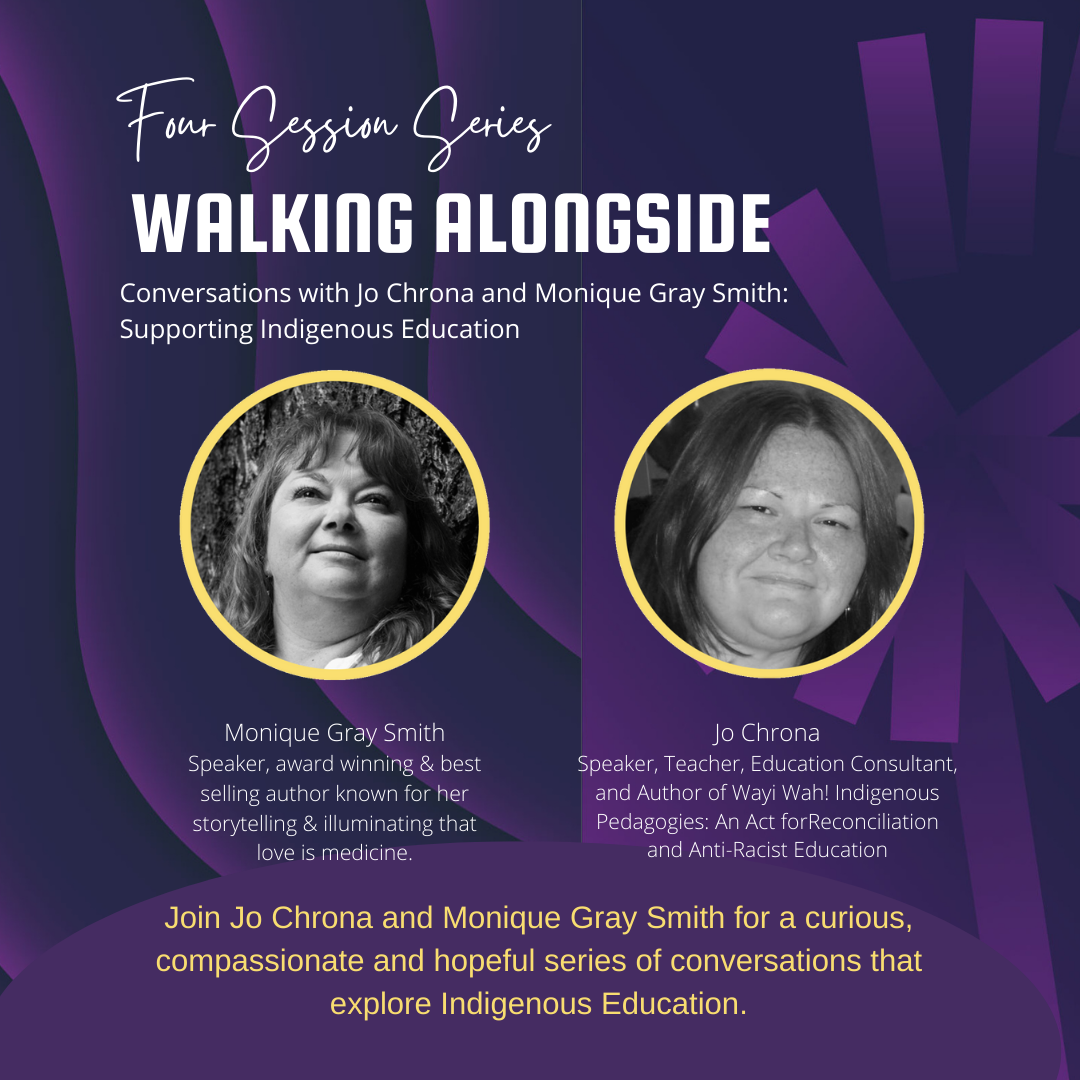
I have the joy of being able to have an extended conversation with Monique Gray-Smith. In this 4-part webinar series we explore the synergies between our work in a combination of presentation and conversation. Attendees will be able to add questions to the webinar Q/A. People can register for the individual sessions or for the full series.
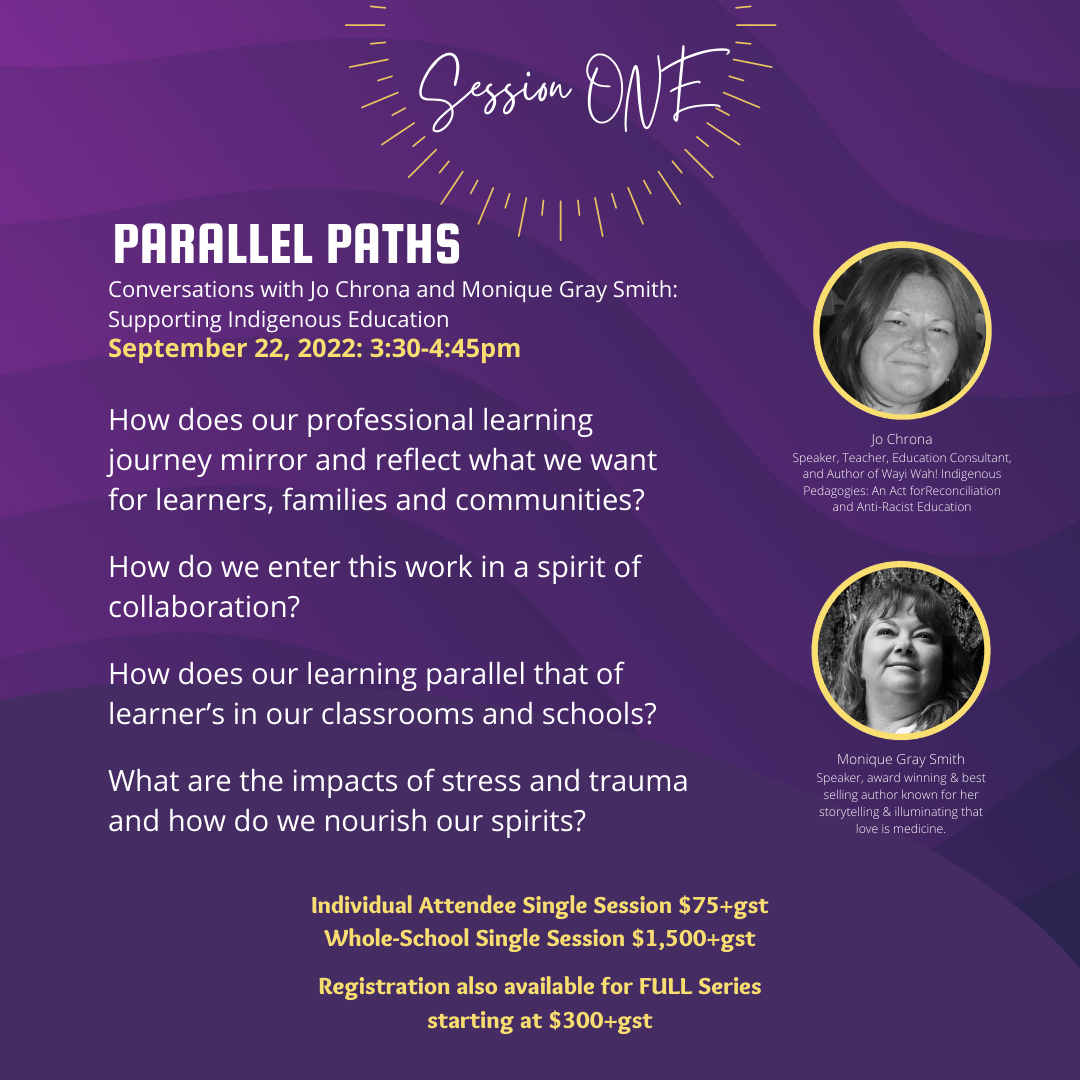
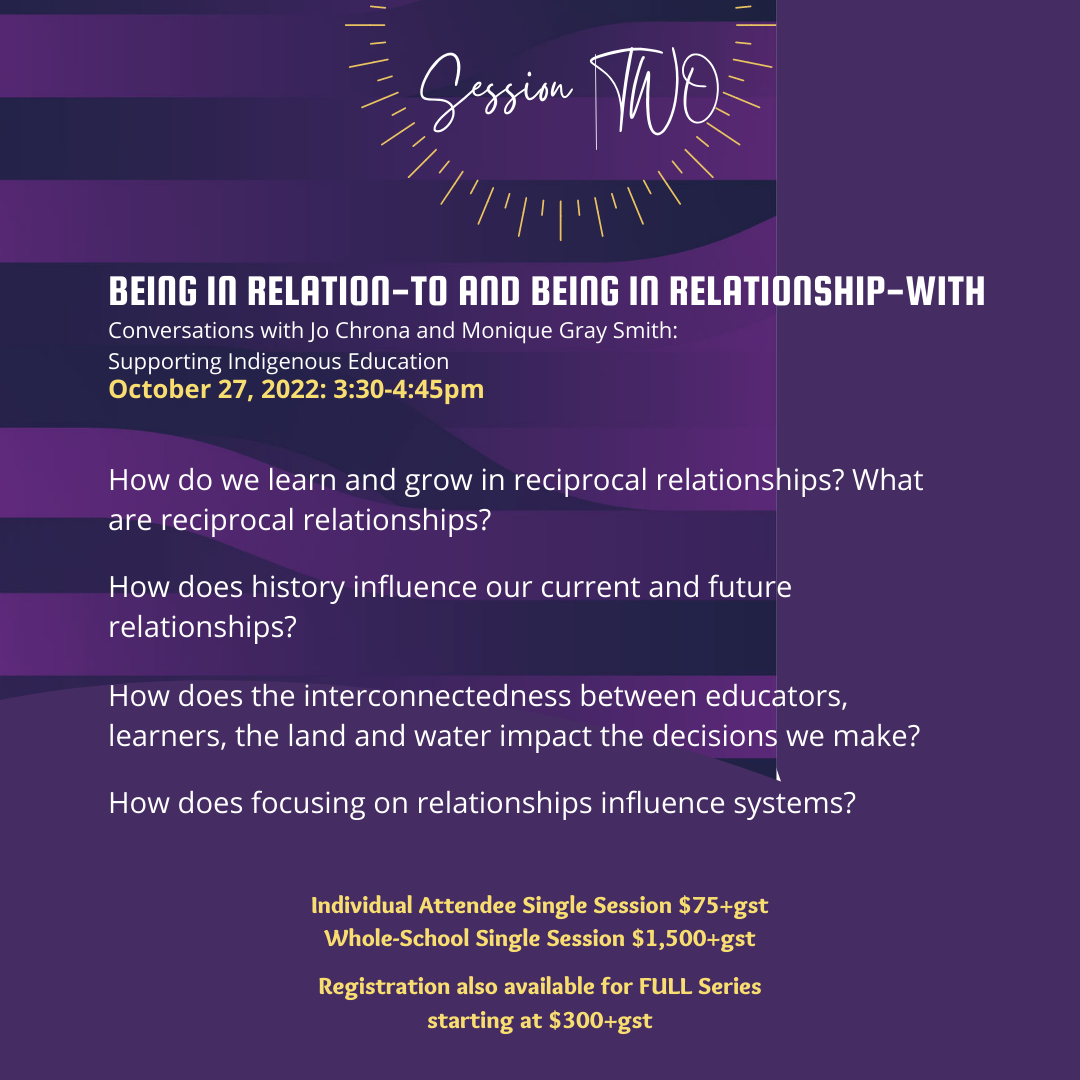
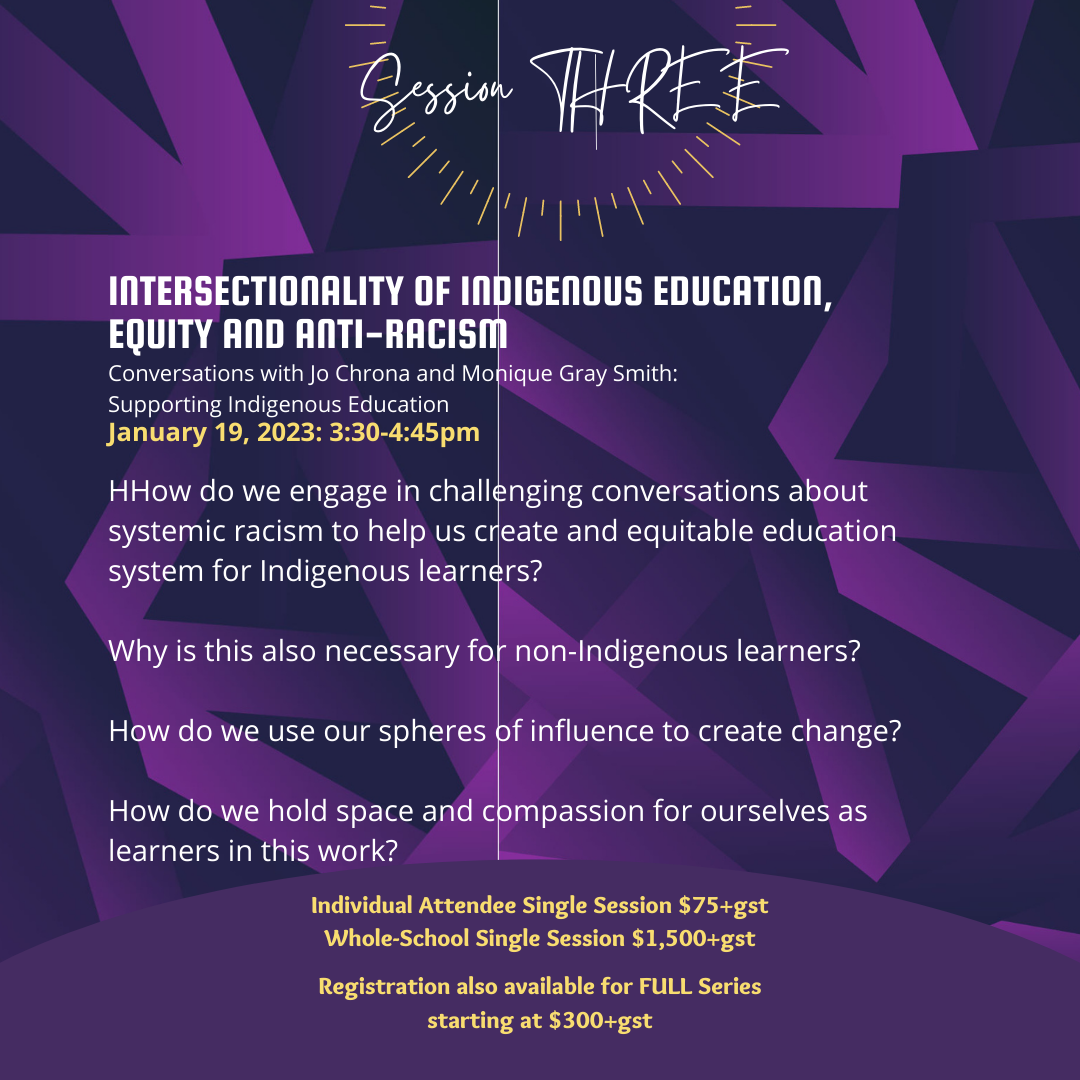
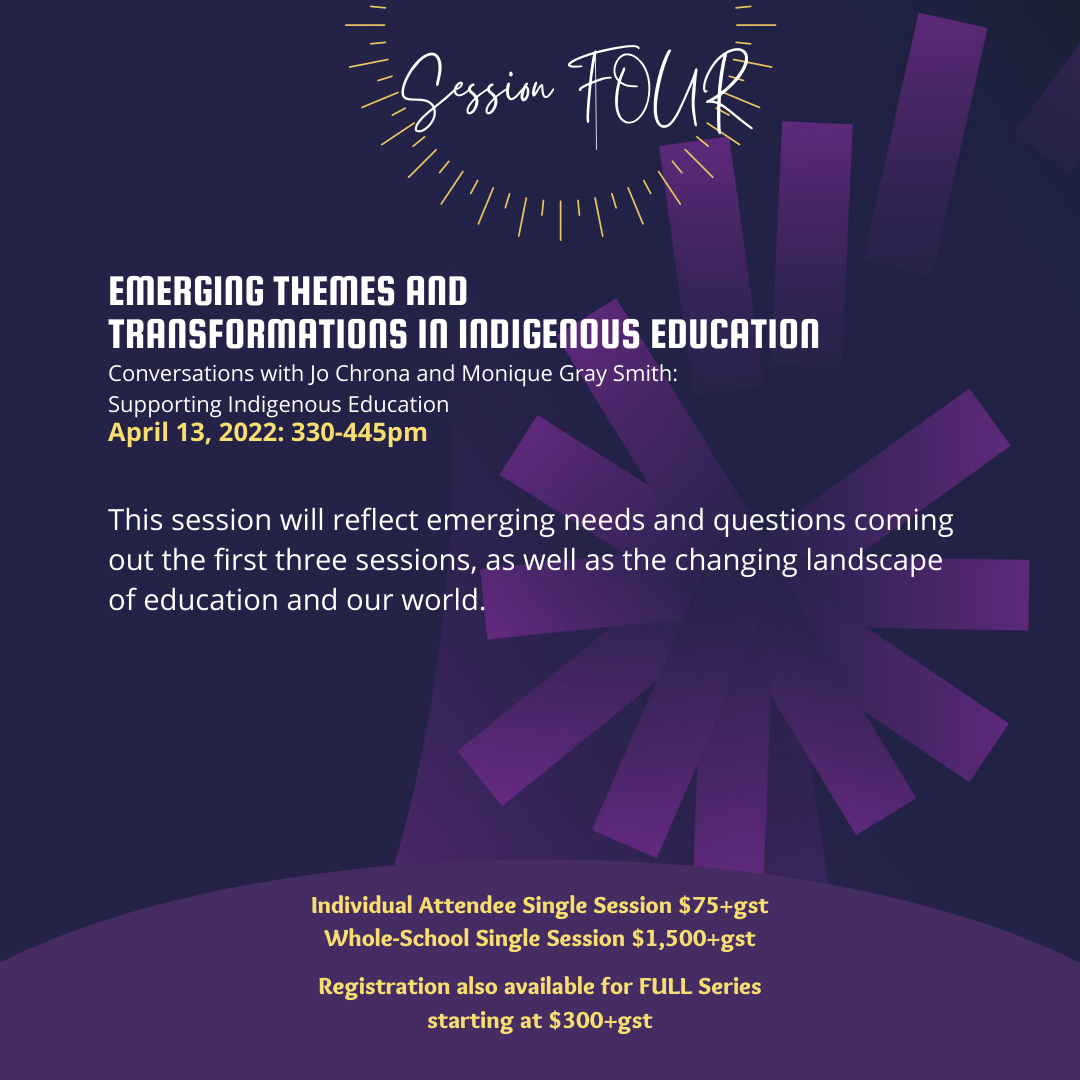
The final session will be developed more fully based on the questions folks have asked in previous sessions.

A number of years ago I was part of a small group of English Language Arts (ELA) teachers from across the province who were gathered together to discuss potential directions for revisions to the K-12 ELA curriculum in British Columbia. The Ministry of Education representative had indicated that one of the changes that would be included in any curriculum revision was to increase Indigenous knowledges and perspectives in the mandated curriculum.
A long-time teacher was not completely comfortable with this announcement. He said “I understand the need for cultural relevancy and cultural responsiveness. If I have Indigenous learners in my class, they need to see who the reflected in the classroom. But I don’t have any Indigenous students. There may be two in the entire school. I have students whose families have been in Canada for multiple generations and students whose families have come to Canada from different countries around the world in recent years.” He then asked “Why is Indigenous content and perspective now going to be specifically mandated in the BC curriculum, and not the heritages of all other students in our schools?” He suggested that if Indigenous content was specifically mandated, then every other cultural heritage should be mentioned or else we were privileging one heritage over another.
I thought about this for a minute before responding. I knew that this was going to be a common question in the years to come.
I asked him to think about the places in the world where his students or their families had come from, whether they arrived last week, or had been in Canada for over 150 years.
I asked if the languages of those places are still being spoken in those places.
I asked if the knowledge systems of the people of those places was still being taught and learned in schools there.
I asked if the written and oral literature connected to the land of those places was still growing and thriving.
He thought about these questions for a moment before nodding his head, “Yes, yes, and yes”.
I reminded the whole group that this is the only place in the world that the First Nations languages (in the land we now call British Columbia) exist, where the literatures of Indigenous here spring from, where the knowledge systems of First Nations here is rooted in the land. If the languages cease to spoken here, if the knowledges and perspectives are not taught and learned here, they do not exist elsewhere in the world.
The teacher came to speak with me a little later that day. He said “I get it.” And asked rhetorically, ‘If [the learning does] not [take place] here, then where?’”
This conversation highlights the unique work of Indigenous education in Canada. Indigenous education is not multicultural education. Multiculturalism in Canada, in its popular interpretation, recognizes, celebrates, and embraces existing cultures from around the world. Officially, it was a political strategy made into policy in 1971 “as a way to address contesting language, cultural, and land claims within the nation, and it has since been widely explained, defended, and critiqued” (St. Denis, 2011, p. 307). Understandably, many people still use that framework to emphasize the need for us all to embrace a culturally diverse society. Our humanity is deepened when we do not seek to merely “tolerate” cultural difference, but when we value and celebrate the richness that cultural diversity brings.
However, attempts to embed Indigenous education within a conversation about multiculturalism denies the distinctness of First Nations, Inuit, and Métis, and undermines actions to acknowledge Indigenous rights. Not only do First Nations, Métis and Inuit not have representations of their cultures elsewhere, trying to embed First Nations, Inuit and Métis into the multicultural narrative ignores, or tries to deny, specific land-based rights that Indigenous people have in Canada.[1]
A document designed to help educators in Manitoba create inclusive and equitable classrooms and schools for First Nations, Métis, and Inuit students and all students shares the following:
The psychological, social, and multi-generational damage caused by being marginalized and excluded in your own land, by having your land appropriated, and by having your freedom and rights systematically denied or restricted is immense, deep, painful, and long-lasting. The sovereignty and freedom FNMI peoples enjoyed before the arrival of Europeans was appropriated by the new colonial government. Their traditional education and governance systems, their ways of life, their languages, ceremonies, communities, and even their children were targeted for assimilation, and became managed through oppressive federal policies. Manitoba Education and Training (2017)
When we address the lack of knowledge and understanding about communities, cultures, histories, and rights of Indigenous peoples in Canada, we will have an education system that is responsive to First Nations, Inuit, and Métis learners. When we ensure that all Canadians know the truth of our collective histories and understand the contemporary contexts of the diverse First Nations, Inuit and Métis (including the unique legal relationships between First Nations, Inuit, and Métis and the rest of Canada) we create the conditions to move forward as a country in a good way.
[1] For more information about Land and Rights, see https://www.canada.ca/en/immigration-refugees-citizenship/corporate/transparency/committees/inan-jan-28-2021/inan-section-35-consitution-act-1982-background-jan-28-2021.html; https://indigenousfoundations.arts.ubc.ca/land__rights/ ; and https://www.rcaanc-cirnac.gc.ca/eng/1100100031843/1539869205136
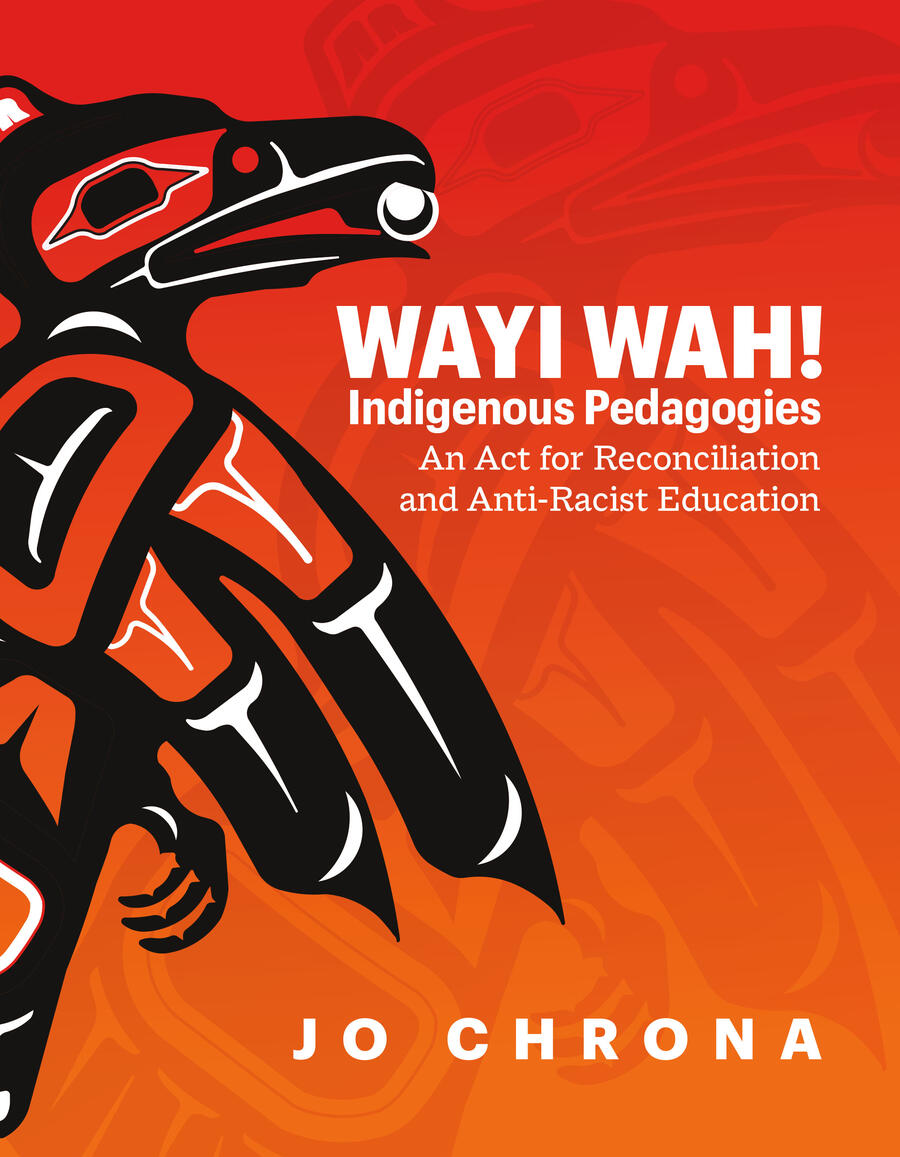
(This post is a snippet of Wayi Wah! Indigenous Pedagogies: An Act for Reconciliation and Anti-Racist Education. Anticipated publishing date September 6, 2022)

Understanding just how pervasive various forms of racism are in education systems will be the continued work of the next few years. As we learn about, and begin to address, some types of systemic racism, such as the racism of low-expectations, we also need to be aware of other ways racism can be (and is) reflected in education. Epistemic racism refers to the valuing and devaluing of knowledge systems of specific cultures. In education, it is often reflected in what is mandated in curriculum and included in resources, and may be one of the most challenging forms of racism to address. Generally, Canadian education systems privilege and centre Euro-western knowledge systems, and this centering is so deeply embedded that some people think that the values and perspectives reflected by Western knowledge systems are universal, rather than cultural.
Education systems are microcosms of the larger society. When racism exists in society, we would be naïve to assume it is not also present in our education systems. We are challenged in Canadian education systems because these systems have taught us (explicitly or by omission) all that Indigenous knowledges do not exist, or are of less value than Euro-western knowledge systems.
In reality, Indigenous peoples hold an extensive wealth of knowledge, even if this knowledge has not always been recognized by post-industrial Euro-centric/Western cultures (Battiste, 2005). As we begin to unpack the epistemic racism that has rendered Indigenous knowledge systems invisible, more people will be able to understand the importance of these knowledge systems and perspective as necessary in both our learning environments, and in a 21st century world. Ideas that Indigenous knowledge and perspectives only had value historically and are not relevant to the world of today and tomorrow need to be challenged. Barnhardt and Kawagley (2005) write
“Indigenous peoples throughout the world have sustained their unique worldviews and associated knowledge systems for millennia, even while undergoing major social upheavals as a result of transformative forces beyond their control. Many of the core values, beliefs and practices associated with those worldviews have survived and are beginning to be recognized as having an adaptive integrity that is as valid for today’s generations as it was for generations past. The depth of [I]ndigenous knowledge rooted in the long inhabitation of a particular place offers lessons that can benefit everyone, from educator to scientist, as we search for a more satisfying and sustainable way to live on this planet.” (p.9)
However, before we can fully engage in understanding the inherent value in Indigenous knowledges, we need acknowledge that Euro-western knowledge systems are not the only cultural knowledge systems with value. And, we do not have to engage in a debate of one knowledge system or the other; there is room for complementary learning. In order for us to understand how that can happen we first need to be willing to create the space and make the time for us to learn what we need to learn. This will not happen quickly. It is not the result of having one conversation, reading one book, participating on one professional development session, or implementing a lesson. These actions can be a beginning, but they are only a beginning. The First Peoples Principles of Learning include more context about Indigenous knowledges, and their connections to local contexts, but I wanted to address here one of the common signals of epistemic racism – the misperception that the infusion of Indigenous knowledges reduces education standards.
In a society steeped in Indigenous-specific racist perspectives, it is not be surprising to many people that there is active resistance by some educators in K-12 and post-secondary institutes to the inclusion of authentic Indigenous knowledges and perspectives in all curricular areas.
A few years ago I was working with a group of educators who taught various subject areas at the secondary level and I was sharing resources that were available to respectfully integrate Indigenous knowledges in secondary classrooms. Many folks in the room were excited about this and wanted to spend time exploring the authentic Indigenous resources that had been developed for teachers in BC to use. A couple of educators however, made it plain that while they had to be there (as this was a mandated professional learning session) they did not see a value in even examining the resources. When asked why, one educator stated that his students would be going onto elite universities and colleges, so Indigenous knowledge is not going to be important for them. That statement reflected so much ignorance I was not sure where to begin to unpack it. At its heart was a blind assumption that there was nothing of value for his students to learn from Indigenous cultures. But it was also a statement that he also thought that there was nothing that he had to learn as well, that he had already learned everything that he ever needed to know.
I wish this was an isolated experience, that other teachers in the last couple of years have also not said that ”there is no such thing as Indigenous knowledge in Science or Math”, or that “Indigenous literature was not sophisticated enough to be taught in secondary English Language Arts courses”. But this is where we still are, and it shows how much more work we need to continue to do to challenge the narratives of Indigenous knowledges being “less than”. As much as I try to focus on the voices of thousands of other educators across the province who are embracing learning about Indigenous knowledges, and who are creating powerful and rich learning environments that reflect a value for Indigenous knowledges, my mind keeps going back to those who resist doing so. Whether the resistance comes out of fear of making a mistake, or out of racist perspectives, the results are the same – we will continue to have learners leave our education system with the same blind spots and ignorance about Indigenous peoples, cultures, and histories that has plagued Canada’s education systems.
As you might imagine, people who believe that the infusing Indigenous knowledge in learning environments means reduced learning standards, usually understand very little about Indigenous knowledge systems. What they think they know is often based on ignorance, or on just plain stereotyping and racist perspectives. It is important for us to remember that the K-12 and post-secondary education systems that most of us went through were prime examples of epistemic racism in action. Most non-Indigenous educators, and even some Indigenous educators, never had the opportunity to learn about Indigenous knowledge systems and perspectives.
Combatting epistemic racism in K-12 is vital for Indigenous learners and communities. One of the effects of the absence of Indigenous knowledges in learning environments is referred to as cognitive imperialism, a concept that describes the “white-washing” of the mind of Indigenous peoples that is the result of forced assimilation that comes when Indigenous knowledge systems are absent, denied, or devalued in the education systems (Battiste, 2013). This concept includes cultural minorities been led to believe that challenges they have been faced with are the result who they are, rather than the challenges being created by systemic racism. If we are committed to moving forward to create healthy and strong relationships between Indigenous peoples and Canada, then all of our education systems need to ensure that we are not reinforcing (intentionally or unintentionally) cognitive imperialism.
In addition to respectfully and meaningfully infusing Indigenous knowledges and perspectives in learning environments to be more responsive to First Nations, Métis and Inuit learners, we need to help each other understand how essential this is for non-Indigenous learners as well. Integrating (unappropriated) Indigenous knowledge systems and perspectives into all learning environments helps address and eliminate continuing colonial attitudes. In doing this, we help ensure that other Canadians do not grow up with the lack of knowledge and understanding of Indigenous peoples that permeated the systems that many of us came through. It is important for all learners to see the value for Indigenous peoples and cultures reflected in the physical environments of their schools, in their curriculum, and in their classroom resources. This is a vital part of Reconciliation through education.
Reflection Questions
Taking Action
Moving from the Claiming of “New” Lands to “Discovering” New Knowledge
A different kind of example of epistemic racism has become evident in instances where Indigenous knowledge and/or perspectives are only perceived as important when validated by non-Indigenous people. This is also reflected in situations where non-Indigenous educators “discover” and claim as new or innovative, knowledge or perspectives that have already existed and been practiced in Indigenous cultures in Canada for thousands of years.
Let us look at the example of place-based or place-conscious learning – the awakening understanding about the value of connecting learners, and learning, to the land. Relationship to land and place is deeply rooted in many Indigenous cultural constructs as a foundation for teaching and learning. Living and learning is intimately attached to sense of place, connection to the land, and learning from the land. The community and natural environment are regarded as the “classroom”, and “land was regarded as the mother of all people” (Kirkness, 1998, p. 10).
In recent decades more educators in Canada have come to understand the learning potential for students learning on, and from, the land. Education systems have begun to embrace not just place-based learning, but understanding that the land is also our teacher, that we are informed by the land we are on. However, there has also been a tendency to treat this understanding by non-Indigenous peoples as a “new discovery” rather than acknowledging that it has been a foundation of Indigenous knowledge systems. I understand why this may happen; if non-Indigenous peoples have not had the opportunity to learn about Indigenous knowledge systems, then they may not realize that what is new to them is not new to Indigenous peoples. However, in the current contexts of this country, I would argue that it is the responsibility of all educators to be engaging in their learning about Indigenous knowledge systems. A part of the work of building a relationship with Indigenous peoples is explicitly honouring the knowledge that has been and continues to be foundational to so many Indigenous cultures.
I was talking with a small group of friends who are also Indigenous educators. We were discussing the recent changes to the British Columbia curriculum to enable educators to be more responsive to diverse learners and community needs, to focus on deeper learning of concepts, and emphasize the development of core competencies such as critical thinking, communication, positive personal and cultural identity and personal and social awareness and responsibility. We all acknowledged that the transformation that was being undertaken was long overdue and sorely needed to improve our K-12 system. However, one Indigenous district leaders noted with some exasperation, “I do wish though that [the Ministry of Education] would stop referring to all of this as ‘new’. It is new for them; it is not new for us. Sometimes it feels like someone stole my car, painted it a different colour, and is trying to sell it back to me. This transformation of the K-12 system is already going in the direction of what so many Indigenous peoples already know.”
So, why is it important to name the Indigenous knowledges that already exist, and think carefully when we label some thing as new or innovative when it is only new or innovative to non-Indigenous peoples? Because, when we ignore (out of ignorance or indifference) that the knowledge has already existed in Indigenous cultures prior to it being learned in non-Indigenous cultures, we contribute to the misperception that Indigenous peoples did not (do not) have robust knowledge systems, and that there was little value in Indigenous cultures. This kind of thinking (and acting) continues to erase Indigenous knowledge systems in Canada. If we are to move forward as a country, non-Indigenous education (and other) systems will need to disrupt and change perspectives and narratives that do not acknowledge the existence and value of Indigenous knowledges. Ignorance of that, intentional or otherwise, will only contribute to continued colonization.
Reflection Questions
Taking Action
Read, Listen, or Watch
References
Barnhardt, R., & Kawagley, A. O. (2005). Indigenous knowledge systems and Alaska Native ways of knowing. Anthropology and Education Quarterly, 36(1), pp. 8-23. Retrieved from http://ankn.uaf.edu/Curriculum/Articles/BarnhardtKawagley/Indigenous_Knowledge.html
Battiste, M. (2005). Indigenous knowledge: Foundations for First Nations. Retrieved from: https://www.researchgate.net/publication/241822370_Indigenous_Knowledge_Foundations_for_First_Nations
Battiste, M. (2013). Decolonizing education: Nourishing the learning spirit. Saskatoon, SK, Canada: Purich Publishing Limited
Kirkness, V. (1998). Our peoples’ education: Cut the shackles; cut the crap; cut the mustard. Canadian Journal of Native Education Canadian Journal of Native Education, 22(1), 10-15.

In recent years, often in relation to Reconciliation, the concept of decolonizing various public sectors has gained traction. But what does this mean? I often wonder if it is possible to decolonize systems, especially our education system, which is an inherently a colonial construct. In education these days, it seems to me that decolonization has become a buzzword for many non-Indigenous folks to use to justify any change that they want to make. In Canada, colonization has most signficantly impacted Indigenous peoples, so I am especially sceptical when non-Indigenous folks use the concept to justify changes they want in education, especially when those changes are contrary to the priorities of Indigenous leadership. Talk about the saviour mentality at work!
If we define decolonization as the continuing process of critically examining, and challenging beliefs, values, structures and processes that that are steeped in mindsets that implicitly or overtly devalue or exclude Indigenous peoples, knowledge systems, and processes, then yes, we can use the term. I still rarely do though, and instead, I prefer to use the concepts of Reconciliation and the implementation of the United Nations Declaration on the Rights of Indigneous Peoples (UNDRIP).
Before I talk about the concept of Reconciliation in education, it is important to acknowledge that there are Indigenous peoples in Canada who challenge the possibility that Reconciliation can even occur, and I understand that perspective. The extent to which a person perceives it as possible depends on how one defines what Reconciliation means. If one defines Reconciliation as the re-establishment of a broken relationship, then this raises the question of how we can reconcile something that was never whole to begin with.
Instead, I understand Reconciliation as the process of the work of every Canadian, individually, and collectively, personally and professionally, to understand the truths of Canada’s collective past, how these truths affect our lives today, how we can address the legacies of the past, and create changes to the present to move forward. Education systems play a vital role in this work. Integral to this process is responding to the priorities of, and working in partnership with, Indigenous peoples, and implementing the United Nations Declaration on the Rights of Indigenous Peoples (UNDRIP). The Truth and Reconciliation Commission of Canada calls the UN Declaration “the framework for reconciliation at all levels and across all sectors of Canadian society.”
What does some of the work of responding to UNDRIP in the context of education require?
It also asks us to think not only the land we occupy, but also the role of colonization in claiming that place, and implications for identity and belonging for each of us.
So what does this mean for education systems? For individual educators in our various roles?
The process of addressing the harms of colonization begins with a critical examination of paternalistic or racist mind-sets and attitudes about Indigenous peoples, cultures, and knowledge systems that endure today. It is that simple, and that challenging.
Moving forward means we examine what aspects of our education system, schools, or classroom practices, continue to ignore or devalue Indigenous peoples, cultures, community structures and processes, or knowledge systems. We examine how overt, systemic, and epistemic racism play out in classrooms, schools and districts. And we respond to the priorities of Indigenous leadership about what needs to change.
It is as a process – a journey that we are navigating – rather than a destination we will arrive at.
Questions for Reflection
Taking Action – General
Taking Action – Educational Leadership Related
Read/Listen or Watch
(This post is a snippet of Wayi Wah! Indigenous Pedagogies: An Act for Reconciliation and Anti-Racist Education, anticipated publishing date September, 2022)
We all have biases that we have developed based on our life experiences, and how we have interpreted those experiences. Biases serve a purpose for us as thinking short-cuts that help us organize our perceptions of the world.
Our professional lives are reflection of the personal values, perspectives and biases we hold and carry, so it is important to be aware of how our conscious and unconscious biases affect the decisions and choices we make.
So what do we do? We think critically about what we know versus what we assume.
This work asks us to interrogate what we “know” about people, and create the possibility that what we know is based on assumptions and or biases that limit both learners (and ourselves). This is about changing how we perceive and interpret. It is about how we make sense of what we know. Some of the conscious biases we may hold are reflected in assumptions about Indigenous learners. Similar to how we act on our biases, we all have assumptions that affect our decisions. As educators, it is important to pay attention to the assumptions we may hold because we can act on those assumptions in ways that can limit, or even harm, learners.
Surfacing assumptions is hard to do, but we can only do the work of challenging assumptions, when we can name what we think. The following are assumptions that continue to permeate many schools and classrooms.
What are some assumptions that we need to challenge?
Assumption – We teach in culturally neutral education systems. We do not. We teach in systems that have always reflected value systems of specific cultures. Our current systems generally reflect a valuing of Euro-Western knowledge systems and perspectives about effective pedagogy. When we understand that our systems currently reflect specific cultural perspectives, we can think about what the values are that have influenced our system. We can also create some room to look at how Indigenous knowledge systems, including knowledge about approaches to teaching and learning, can help us create better education experiences for learners (and ourselves).
Assumption – Indigenous pedagogies are limited and simplistic or are about lowering standards. Indigenous pedagogies can create for effective learning environments in ways that support high-expectations for learners and support the whole learner. The idea that Indigenous pedagogies means lowered standards is often connected to lack of knowledge about Indigenous cultures and knowledge systems, or is the result of outright racist assumptions about Indigenous cultures as devoid of knowledge.
Assumption – Indigenous education is only important if I have Indigenous learners. It is important that every Canadian have better awareness and knowledge of our collective histories, and also develop deeper understanding about the relationships between Indigenous peoples and Canada today. This means that all learners (and adults) will need to engage in learning about, from, and with Indigenous peoples and cultures in Canada. It is the only way we will be able to move forward in a good way as a country.
Assumption – If education systems are not working for learners, they need to change to fit into existing education systems. Effective education systems meet the needs of the learners they serve. Period. Full stop. Exclamation point! (Can you tell that I feel strongly about this?) If an education system is not meeting the needs of learners to achieve education outcomes, and to do so in ways that honour support the well-being of the learner and community, what is the point of the system? Our work is not to change learners to meet the needs of systems. It is to support learners to be successful in developing the knowledge, understanding and skills we need to live good lives – for ourselves and for our local and global communities.
Assumption – First Nations, Métis or Inuit learners cannot achieve success in every facet of education. Perceptions that Indigenous learners cannot achieve in any area of education are usually the result of colonial stereotypes about Indigenous peoples, the effects of low-expectation, lack of cultural relevancy, and/or education systems where Indigenous learners do not feel valued and respected. Where disparities in education outcomes exist, our systems have previously placed the responsibility for that on the abilities of the learners (and have focussed on a deficit model of education). More educators are now understanding that our systems need to be more aware of how systemic racism (in various forms) in our systems have created challenges for many Indigenous learners.
Assumption – Indigenous peoples in Canada are a homogenous group. There is as much diversity among Indigenous learners as there is among any other group of learners. It is also important for all Canadians to understand the diversity, not only between First Nations, Inuit and Metis, but also the significant diversity that can exist from First Nation to First Nation.
Assumption – If I just treat everyone the same, there will be no racism. This perspective often co-exists with the idea that educators are culturally neutral, or that cultural perspectives and knowledges that are reflected in our systems are the only ones of value. It is often promoted by people who have not critically examined power differences between majority and minority cultures. The idea that we just treat everyone the same erases our ability to actually see and understand others.
Questions for Reflection
The “Yes, but…”
In naming assumptions, we may also need to be mindful about the tendency to reply with the “yes, but…” response. The “yes, but…” is the way to avoid engaging in challenging assumptions that create barriers for learners. The “yes, but…” is often connected to some of our conscious or unconscious biases, and may unintentionally justify a status-quo that perpetuates types of racism and inequity. Doing the (hard) reflective work of surfacing and challenging our biases can help us avoid some of the patterns of thought and action that limit learners. For example, many educators engage in confirmation bias or fundamental attribution bias when they interpret new information in ways that support existing beliefs about Indigenous peoples based on stereotypes and ignorance, or when they attribute any challenges facing some First Nations, Inuit, and Métis learners, families and communities as direct results of their internal qualities, instead of understanding how many contemporary contexts are connected to historical and/or on-going colonialism and racism (Hampton & St. Denis, 2002).
How do we recognize our unconscious biases?
People are too complex for there to be a one-size-fits all approach to challenging assumptions and biases in anti-racism work, but there are some approaches that may help:
We can remember that it is easy to make a change if the change is convenient and does not ask us to fundamentally challenge our ways of thinking and acting. Anti-racist work asks people to do just that.
Questions for Reflection
Further Learning
(This post is a snippet of Wayi Wah! Indigenous Pedagogies: An Act for Reconciliation and Anti-Racist Education, anticipated publishing date September, 2022)

While educators are encouraged to integrate Indigenous knowledges into schools and classrooms, people have also become aware that respectful inclusion of Indigenous resources means avoiding cultural appropriation or exploitation, and misusing or misrepresenting Indigenous knowledges.
Educators often ask about the difference is between cultural appreciation and cultural appropriation. In appreciation, we can learn about and understand other cultures, and in a cultural exchange there is an intentional sharing of cultural knowledge. These are both different than cultural appropriation of Indigenous knowledge which occurs when non-Indigenous people take elements of Indigenous knowledge as their own, without permission to do so and without recognition of where the knowledge comes from, and how it exists within specific contexts. Cultural appropriation is especially significant to be aware of when there is a power imbalance between the cultures, or when there has been historical suppression of the culture that is being appropriated. The power imbalance is what helps define the difference between a colonizing culture taking and using as its own aspects of a marginalized culture, and when a historically marginalized culture adopts elements of the colonizing culture (which can also be an assimilative process).
One common form of cultural appropriation found across many art forms (including text/literature) are works that mimic Indigenous art forms, but were created by non-Indigenous artists who indicate that they were “inspired” by Indigenous art or people. It is not respectful for non-Indigenous folks to try to create Indigenous themed works of art or literature no matter how much they may be “inspired” by Indigenous works. Besides often misrepresenting Indigenous cultures or knowledge, this kind of action takes space and opportunity away from authentic Indigenous representations.
Cultural exploitation is another a term people may be familiar with. Indigenous knowledges are usually context specific and connected to place, people, and other knowledge and protocols; when aspects of these knowledge systems are taken out of context they can be misinterpreted, misrepresented or misused. This is often reflected when, in an attempt to include Indigenous knowledges in schools, educators end up trivializing cultural knowledge by equating it with craft projects. For example, learning about the variety and meanings associated with the various cultural poles and pole-raising practices of First Nations on the coast of British Columbia does not need to be accompanied by learners making toy “totem poles”. Learning about the history and relevance of button blankets for some First Nations does not mean students making paper or craft representations of the blankets.[1] Instead, students can learn about these, and other cultural artifacts, in terms of their cultural significance and how they are created. Students can learn about the knowledge and skills required to create cultural artifacts, or the knowledge and skills required to engage in cultural knowledge-based processes. Students can be exposed to authentic examples of Indigenous cultural knowledges in contexts that the holders of that knowledge deem appropriate.
People can continue their own learning about respectful terminology relating to Indigenous cultures and understand why “costume” is a disrespectful way to refer to regalia (and why it is not appropriate to try to use representations of regalia as a costume). Educators could come to understand the significance of regalia, and support Indigenous learners who choose to wear it in school settings.
Cultural exploitation can also serve to perpetuate pan-Indigenous perspectives, where Indigenous cultures are assumed to be homogeneous. It is necessary to understand the diversity of knowledges between and among Indigenous peoples and respect that protocols and knowledge systems differ between not only First Nations, Inuit and Métis for example, but also from First Nation to First Nation.
Cultural knowledge systems are complex; there are often layers of cultural knowledge and protocols that need to be in place for many processes practices, and it is important that non-Indigenous educators understand that not all cultural practices can or should be replicated in classroom settings.
It is with these contexts in mind that we might understand how important it is that Indigenous peoples have the right to control how Indigenous cultural knowledge is used, and with whom it is shared.
A final note on appropriation and misrepresentation. Current communication technologies have made it easier for non-Indigenous people to masquerade as Indigenous in the promotion of ideas or products in on-line. Easy access on-line to representations of Indigenous cultures is more easily used as “inspiration” for some non-Indigenous artists and writers to create works that might look like authentic Indigenous works, but are not. Not only does this result in inauthentic representations and/or promoting “pan-Indigenous” perspectives, it also continues to displace or suppress authentic Indigenous voice. In a country where colonial assimilation policies have attempted to erase Indigenous peoples, cultures and histories, we need to be vigilant about supporting authentic Indigenous text/literature and art.
Taking Action
Classroom/Learning Environments
Educational Leadership
Read, Listen, or Watch
[1] There are many ways to learn and teach about these elements of First Nations cultures without trivializing them. One example can be found in the FNESC Math First Peoples Teacher Resource Guide http://www.fnesc.ca/math-first-peoples/
(This post is a snippet of Wayi Wah! Indigenous Pedagogies: An Act for Reconciliation and Anti-Racist Education, anticipated publishing date September, 2022)
If we are respecting the First Peoples Principles of Learning and Indigenous knowledge systems, we need to ensure that our classrooms and schools are full of rich, authentic Indigenous resources. This is important for First Nations, Inuit and Métis learners who deserve to see positive and dynamic representations of who they are in their learning environments. This is also important for non-Indigenous learners, so that they do not leave our education systems with the same gaps in knowledge and understanding about Indigenous peoples in Canada that we may have had in our own K-12 and post-secondary learning.
We know that until quite recently, most student resources contained little or no authentic Indigenous representation. There has been a general absence of Indigenous voice in education resources. In addition, resources that did include Indigenous content, knowledge, or perspectives often implied that Indigenous people only existed in history, and did not reflect the thriving peoples and cultures today. Many resources also often contained inaccurate, racist, or pan-Indigenous representations of First Nations, Inuit, and Métis in Canada. It is helpful to remember that resources that do not differentiate between First Nations, Métis and Inuit, or that assume knowledge and perspectives are the same for all First Nations across this land reflect an inherently racist perspective because they deny the distinctness of First Nations, Métis and Inuit, and the diversity between First Nations.
More educators are now becoming more aware of the need to use authentic Indigenous resources. But what does this mean exactly? In an effort to help educators choose learning resources for their schools that authentically reflect Indigenous peoples in Canada, and help K-12 teachers make more informed judgments about which materials to use the First Nations Education Steering Committee (FNESC) defines authentic Indigenous resources as historical or contemporary texts that
First Nations Education Steering Committee, 2016
These are more than resources that are accurate; they are resources that are created by Indigneous peoples. Using resources created by Indigenous educators, writers, or developers addresses the invisibility of Indigenous voice in our schools and classrooms, and better guarantees more accurate and respectful representations of First Nations, Inuit and Métis. It helps ensures that we are not only learning about – we are also learning from. When we think of resources in the classroom, we can also think about the people who can provide teaching as a resource; this is especially important if we are honouring that much Indigenous knowledge is locally held, and held by people who may share their knowledge orally. Just think about how far it would take Canadian consciousness to fully understand that Indigenous peoples and cultures have rich and vital perspective and bodies of knowledge.
Authentic Resource Evaluation Criteria
Educators who are interested in ensuring that student resources with Indigenous content, knowledges or perspectives are authentic and respectful may also choose to evaluate these resources against the following criteria adapted from Authentic First Peoples Resources for Grades 10 to 12 and Adult Learning (FNESC, 2021). Some statements will be more applicable to some resources more than others. I also acknowledge that the descriptors of excellent, fair, and poor, can be variously interpreted, so it is vital to ensure that Indigenous educators be a significant part of any evaluation process. It can be helpful to review resources collaboratively as this provides the opportunity for professional learning as educators share knowledge and perspectives with each other.
| Excellent | Fair | Poor | N/A | |
| AUTHENTICITY | ||||
| Resource created by, or in significant collaboration with First Nation, Inuit and/or Métis writers, developers, creators etc. | ||||
| REPRESENTATION | ||||
| Recognizes diversity between and among First Nations, Inuit, and Métis (distinct societies, communities, ways of life, histories, languages), including recognition of diversity between First Nations | ||||
| Shows contributions of First Nations, Inuit and/or Métis to contemporary society | ||||
| Represents of First Nations, Inuit and Métis as enduring, not vanishing or assimilated | ||||
| Portrays of Indigenous’ languages and dialects respectfully | ||||
| Representation of individual First Nations, Inuit, or Métis lives, past or present accurately | ||||
| Is devoid of obvious or subtle Indigenous-specific racism or prejudice | ||||
| Avoids stereotypes of First Nations, Inuit, and Métis | ||||
| Uses sensitive language, free from loaded or offensive words | ||||
| Portrays of diversity of human strengths and weaknesses | ||||
| Presents events, issues, problems accurately and respectfully | ||||
| ILLUSTRATIONS (where applicable) | ||||
| Depictions of First Nations, Inuit, and/or Métis ways of life (past or present) are authentic and accurate according to place and time | ||||
| Reflect diversity of First Nations, Inuit and Métis (i.e., recognizes differences between not only First Nations, Inuit and Métis, but also between First Nations cultures) |
What can you do? Move from awareness to action.
Taking Action in Classroom/Learning Environments
Taking Action in Educational Leadership Roles
Reflection Question
How might the use of authentic Indigenous resources, as opposed to resources created by non-Indigenous people, impact
(a snippet of Wayi Wah! Indigenous Pedagogies: An Act for Reconciliation and Anti-Racist Education, anticipated publishing date – September, 2022)
(a snippet of Wayi Wah! Indigenous Pedagogies: An Act for Reconciliation and Anti-Racist Education, anticipated publishing date – September, 2022)

Many people talk about the need to improve education systems, to create system-wide shifts in values, structures, and processes to support equity. However, we often have different visions of what this means based on context(s) we are most familiar with. The focus on what is needed to improve K-12 education systems differs depending in which province, territory, or state the conversation is had.
It is helpful to remember the diversity of the education cultures that currently exist across this continent, and not assume that every education jurisdiction reflects the same level of awareness and understanding about Indigenous education and anti-racism. We need to remember to be thoughtful about how we interpret and apply ideas from other education jurisdictions. If we make pan-education generalizations across multiple education jurisdictions we might create misassumptions about what currently exists to build upon, and may miss the opportunity to respond to the very real needs of where we are. So, it is important for me to be clear about what I mean when I speak about systemic change.
It is an education system that, as a normalized aspect of the educational culture:
We want systems that support every learner to leave our system with “dignity, purpose, and options”.[1] This means that all learners have the knowledge, understandings, skills, and competences to help them take their own next steps in life, whichever paths they choose. When they leave the K-12 system, not only do they still have a passion for learning, but they also recognize that they are valued for who they are. They are grounded in a strong sense of who they are and the strengths they carry in this world. We have a colonial history, where in many cases to be considered successful in the public education system, First Nations, Inuit, or Métis learners have had to suppress pride in who they were, and are, as Indigenous people. A transformed education system will reflect a value for Indigenous peoples and cultures in Canada.
Does this sound highly aspirational and slightly daunting? For some folks, yes. And that is okay. High aspirations are more than good to have; they are necessary. They help us continue to learn and to grow. It is the same thing we ask of learners in our schools.
[1] Network of Inquiry and Indigenous Education, https://noiie.ca/about-us/
"The foundations of Indigeneity are these: values that privilege the interrelationships among the spiritual, the natural, and the self; a sacred orientation to place and space; a fluidity of knowledge exchange between past, present, and future; and an honouring of language and orality as an important means of knowledge transmission." (Greenwood and de Leeuw, 2007)
WordPress.com is the best place for your personal blog or business site.


 Jo Chrona